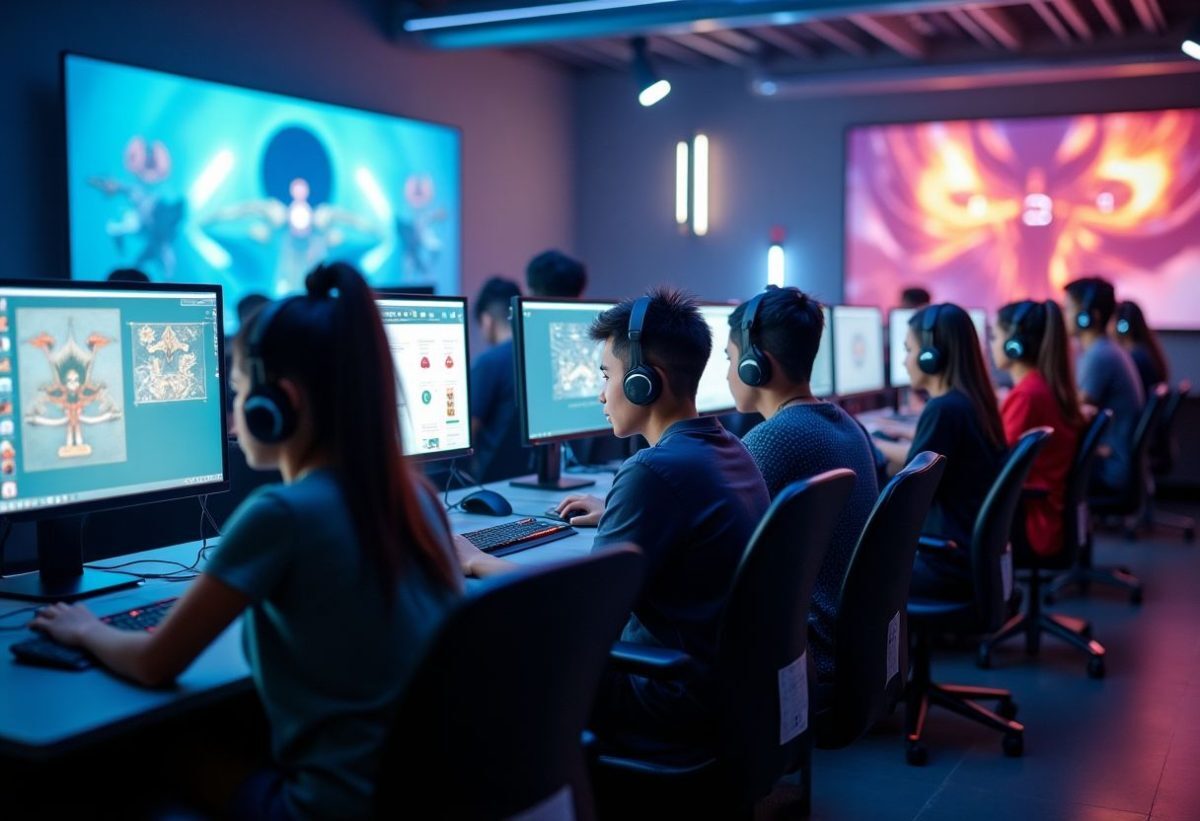
In a world where technology and imagination meet to create immersive experiences, the video game industry has established itself as a major player in the entertainment sector. Growing rapidly, it attracts millions of players and enthusiasts each year. But behind every game lies a team of talented creators, trained in specialized institutions. Video game schools, true melting pots of innovation and creativity, play a crucial role in training these future professionals.
They open the doors to various careers, ranging from artistic design to programming and project management.
The origins and evolution of video game schools
These institutions have not always held the place they do today. Their humble beginnings date back only a few decades, but their growth has been exponential, closely following that of the video game industry itself.
The first dedicated schools emerged in the 1990s, at a time when video games were beginning to be recognized as a legitimate artistic field. Initially, they were often specialized departments within larger universities. Today, entire institutions are dedicated to this art, with comprehensive programs tailored to the latest technologies and market trends.
- Origin of the first schools: born from the evolution of digital technologies and the growing demand for specialized skills.
- The diversity of programs: visual arts, design, programming, project management.
- Global expansion: video game schools are multiplying across all continents, attracting students from around the world.
The heart of education: skills and technologies
Education in these schools goes beyond merely imparting technical skills. It aims to develop a comprehensive understanding of creative processes, interdisciplinary project management, and the importance of innovation.
Programs often include courses on 3D modeling software, game engines, sound design, and player interaction. Furthermore, students are encouraged to collaborate on projects, simulating a professional studio environment.
Partnerships with the industry ensure a constant update of curricula to reflect the latest technological advancements. Students thus have access to the latest versions of tools and can familiarize themselves with current industry standards.
Careers and opportunities: a promising future
Graduates from video game schools have a wide range of professional possibilities. The skills acquired can be applied in various sectors, extending far beyond simple game development.
- Traditional careers: game designer, programmer, 3D artist, animator.
- New horizons: virtual reality, mobile applications, educational games.
- Entrepreneurial opportunities: creating independent studios, developing personal projects.
- International mobility: the skills acquired are sought after worldwide, offering graduates the opportunity to work abroad.
Choosing the right video game school: essential criteria
Making a choice among the multitude of options can be difficult. It is important to consider several criteria to select the institution that best meets your professional aspirations.
The school’s accreditations are an indicator of the quality of its education. Testimonials from former students, often available online, can also provide valuable insights into their experiences. The school’s reputation in the industry is another crucial element, as a good reputation can facilitate access to internships or jobs after graduation.
In conclusion, choosing a video game school can be the first step towards an exciting and rewarding career in a rapidly evolving field. By pursuing specialized training, students not only learn to create games; they learn to push the boundaries of what is possible, to innovate, and to envision new ways to interact with technology.