
The sound of your Marley Stir It Up turntable has become muffled, the highs have lost their clarity, or the stylus skips entire passages. These symptoms point to a worn stylus. Replacing this small component literally transforms the sound reproduction, provided you choose the right model and take care of the following adjustments.
Original cartridge of Marley Stir It Up turntables: what is actually installed
House of Marley states on its product sheets that it uses an Audio-Technica AT3600L cartridge. However, several users have found upon disassembling their cartridge that the factory-installed stylus was actually a Crosley NP-15. This confusion is common and has a direct consequence: ordering a replacement stylus for the AT3600L without checking what is actually installed on your arm can lead to a mounting incompatibility.
Before placing any order, gently remove the cartridge from the headshell and locate the reference number inscribed on the body. If you read “NP-15”, the replacement stylus will be from the Crosley range. If it is indeed an AT3600L, you can aim for an identical replacement or consider an upgrade to the Audio-Technica VM95 range.
When considering to change the stylus of your Marley vinyl turntable, this verification takes less than a minute and avoids an unnecessary purchase.
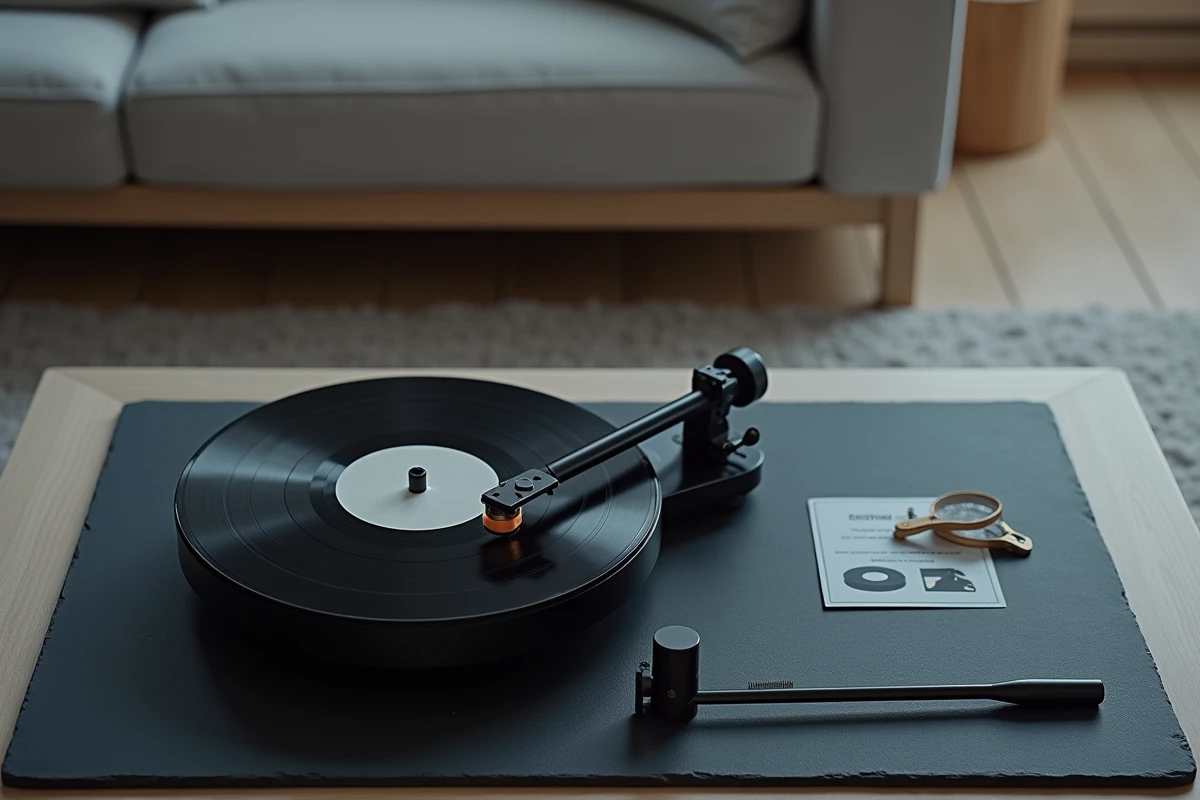
Upgrade to an Audio-Technica VM95E elliptical cartridge: benefits and limitations
The conical stylus originally mounted reads the bottom of the groove quite broadly. An elliptical stylus like the AT-VM95E makes contact with the sides of the groove over a finer surface. The result is audible within the first few seconds: better definition in the highs, clearer separation between the left and right channels.
Have you ever noticed that some vinyl records sound “flat,” as if all the instruments are on the same sonic plane? Switching to an elliptical stylus partially corrects this flaw by reproducing more lateral details in the groove.
The downside that general guides do not detail
Users of Marley turntables who have mounted a VM95E report a side effect: increased sensitivity to poorly conditioned records. An elliptical stylus, because it reads more finely, also picks up imperfections. On a scratched or dusty vinyl, pops and clicks become more pronounced than with the original conical stylus.
This is not a defect of the cartridge. It is a sign that it reads better. If your collection contains many used vinyl records in average condition, keep this point in mind before choosing an elliptical stylus.
- On recent and well-maintained pressings, the sound gain is clear and immediate.
- On worn or poorly stored vinyl, surface imperfections stand out more.
- A good cleaning of the records before listening becomes essential to fully enjoy the upgrade.
Adjusting the tracking force on Marley Stir It Up arms
Mounting a new cartridge without adjusting the tracking force of the arm is like putting new tires on a car without checking the pressure. The Audio-Technica AT-VM95E cartridge requires a specific tracking force indicated by the manufacturer, generally around two grams. Too low a pressure causes skipping, while too high a pressure accelerates wear on both the stylus and the vinyl.
Constraint specific to Marley turntables
Some Stir It Up models have a counterweight at the end of the arm, but the adjustment range may be limited. Users have reported that the counterweight does not go low enough to reach the tracking force recommended for some heavier cartridges. Check the weight of the chosen cartridge and compare it to the adjustment range of your arm before purchasing.
The adjustment is done in three steps:
- Unscrew the counterweight until the arm floats horizontally, perfectly balanced (this is the zero point).
- Turn the graduated ring of the counterweight to zero without moving the weight itself.
- Then screw the counterweight forward to the value recommended by the cartridge manufacturer.
If your Marley turntable does not have a graduated ring, a small precision scale for phono cartridges is inexpensive and provides a reliable measurement.

Alignment of the cartridge after replacing the stylus
A perfectly new stylus mounted crookedly in the groove produces distortion and wears the vinyl unevenly. Alignment involves positioning the cartridge in the headshell so that the stylus follows the groove at an optimal angle.
For Marley turntables, the headshell is attached to the end of the arm by two small screws. Loosen them slightly, then use a printable alignment protractor (a paper template placed on the platter). Place the stylus on the markers of the protractor and adjust the cartridge so that the body is parallel to the reference lines. Tighten the screws once the alignment is correct.
A misalignment of just a few degrees is enough to degrade the reproduction. If after replacement you perceive distortion in the inner passages of the record (towards the center), alignment is likely the cause.
Concrete signs that a stylus replacement is necessary
Waiting until the stylus is completely worn out before replacing it damages the grooves of your vinyl records irreversibly. Here are some practical indicators:
A loss of detail in the high frequencies appears first. Cymbals, sibilance in voices, and the brilliance of brass instruments gradually fade. Then, a slight distortion manifests on the ends of sides, where the groove is tighter.
If the stylus regularly skips on clean and well-maintained records, the tip is likely chipped or too worn to remain stable in the groove. A visual inspection with a magnifying glass may reveal a flat spot on the tip, but the ear remains the best daily indicator.
Replacing the stylus on a Marley turntable remains an accessible operation, even for a beginner. The real difficulty is not the technical gesture, but choosing the right cartridge reference and not neglecting the adjustments that follow. A poorly adjusted new stylus sounds worse than a properly aligned worn stylus.