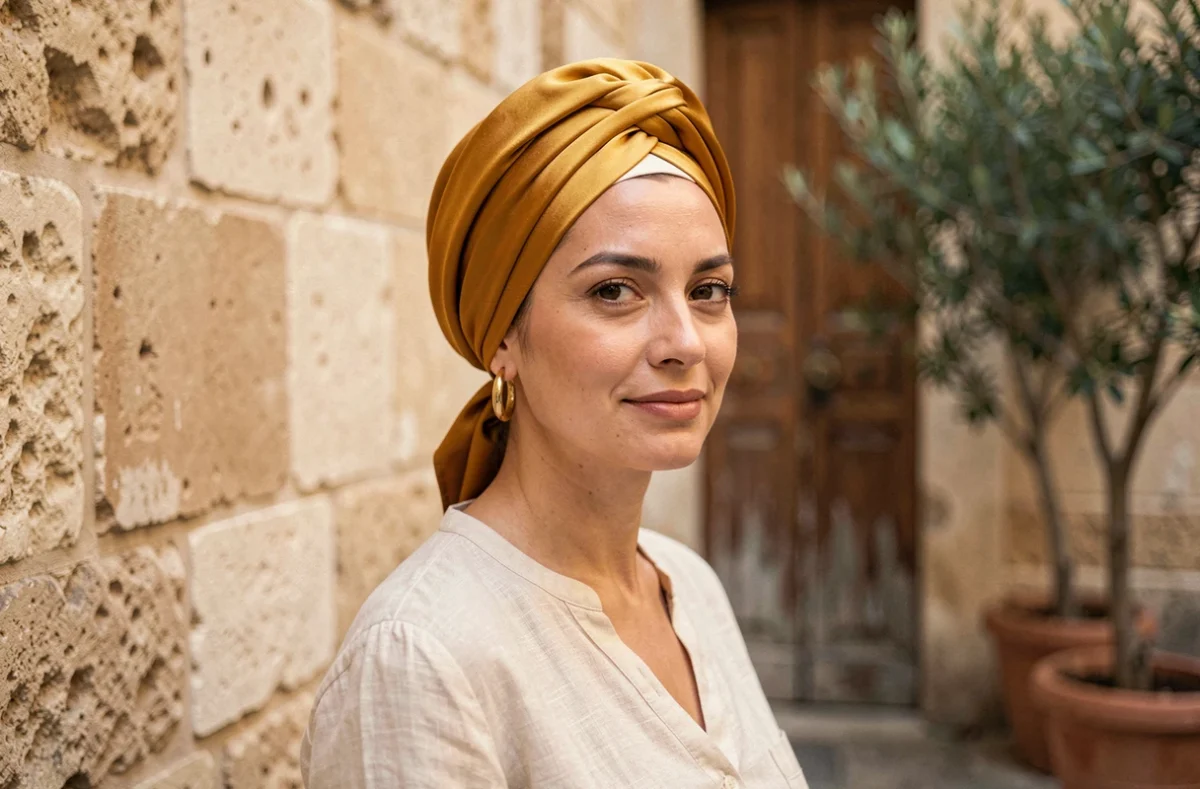
Among hair accessories, the women’s turban holds a special place: it covers, it structures a silhouette, it adapts to very different contexts. But on what concrete criteria do the models available today stand out, and what recent regulatory constraints weigh on their online marketing? An analysis of materials, uses, and the legal framework allows for a factual look at this fashion accessory.
Textile Materials of Women’s Turbans: Comparison of Common Fibers
The choice of a turban primarily depends on the fiber. Each material has distinct characteristics in terms of thermal comfort, support, and maintenance. The table below summarizes the properties of the most commonly used fabrics in the manufacture of turbans.
| Material | Thermal Comfort | Head Support | Maintenance | Main Use |
|---|---|---|---|---|
| Cotton | Breathable, suitable for warm seasons | Moderate (slides little) | Machine washable, quick drying | Daily, post-medical treatment |
| Silk | Thermoregulating | Low (slippery surface) | Delicate wash, low-temperature ironing | Occasions, nighttime hair protection |
| Bamboo Fiber | Very breathable, natural antibacterial | Good (soft and adherent) | Gentle wash, flat drying | Sensitive scalp, summer |
| Synthetic Jersey | Variable depending on thickness | Excellent (elastic) | Machine washable, low wrinkling | Sports, quick styling |
| Linen | Very breathable, cool to the touch | Moderate to good | Wrinkles easily, frequent ironing | Summer, bohemian style |
Silk protects hair fibers by limiting friction, making it a relevant choice for protective hairstyles or sleep. However, its lack of support often requires a more elaborate tying system or an integrated elastic.
Cotton and bamboo fiber dominate the segment of turbans intended for sensitive scalps. Their softness and absorbency make them preferred options after chemotherapy or in cases of alopecia.
To explore the diversity of available models, the women’s turbans on Madame Turban offer a range that covers most of these materials and uses.

Textile Traceability and Online Sold Turbans: What the Law Requires Since 2026
The French regulatory framework has evolved significantly for textile accessories marketed online. The law n° 2026-602 of July 8, 2026 requires online sellers to clearly display the place of manufacture near the price, in a comparable font size.
This obligation directly affects turban brands that sell through their own site or on marketplaces. The information can no longer be relegated to a secondary tab or at the bottom of the page.
Voluntary Environmental Display Regulated by Decree
The decree n° 2025-957 of September 6, 2025 regulates the voluntary display of the environmental cost of textile products. When a brand chooses to communicate an ecological score, it must integrate several parameters: raw materials, manufacturing, transport, and end-of-life of the product.
For a handmade turban produced in small series, this requirement goes beyond a simple composition label. It implies complete traceability of the production chain, from thread to finished product.
Product Safety and European Regulation
The regulation (EU) 2023/988 strengthens safety requirements for all non-food products sold to consumers, including textile accessories. Both small manufacturers and large brands are concerned. For a turban sold online, this means documenting the product’s compliance, even in the absence of specific mandatory certification for headwear.
These three texts outline a landscape where selling a turban online now requires precise documentation, far beyond the mention of “100% cotton” on a product sheet.
Uses of Women’s Turbans Beyond Fashion: Choice Criteria by Context
The turban is not just a style accessory. Its functional uses are diversifying, and the choice of model strongly depends on the context in which it will be worn.
- Nighttime hair protection: a silk or satin turban reduces breakage of textured hair (curly, coily, afro). The smooth fabric limits friction against the pillow and preserves the hydration of the hair fiber.
- Post-medical treatment: models made of cotton or bamboo fiber, with no visible seams inside, minimize irritation on a sensitive scalp. The support from a soft elastic avoids excessive pressure.
- Sports practice: a stretchy jersey turban absorbs sweat while maintaining the hairstyle. It replaces the classic cap or headband with a more structured look.
- Daily protective hairstyle: worn over braids, twists, or locks, the turban limits exposure to mechanical friction and UV rays, extending the lifespan of the hairstyle.

In each case, the determining criterion remains the suitability between the material and the use. A linen turban, ideal for a summer look, will be unsuitable for post-chemotherapy due to its rougher texture.
Turban, Scarf, and Beanie: Technical Distinctions for an Informed Choice
The confusion between turban, scarf, and beanie is common. These three accessories cover the head, but their structures differ.
- The turban is pre-shaped or tied to wrap the head snugly. It offers complete coverage and stable support, without pins or additional accessories in most current models.
- The scarf is a flat piece of fabric (square or rectangular) that can be tied in multiple ways, including as a turban. Its versatility is greater, but its support entirely depends on the tying technique.
- The beanie covers the head by simple slipping on. It does not structure the silhouette in the same way and offers fewer possibilities for visual customization.
Unlike the beanie, the turban alters the proportions of the face by adding volume to the top of the head. This point explains its success in photographic looks and on platforms like Pinterest or Instagram, where silhouette is paramount.
The choice between these three options depends on the desired outcome. For daily use that combines practicality and style, a pre-shaped turban with a simplified tying system represents the most functional compromise. The material remains the parameter to check first, before color or pattern, as it determines the real comfort over several hours of wear.