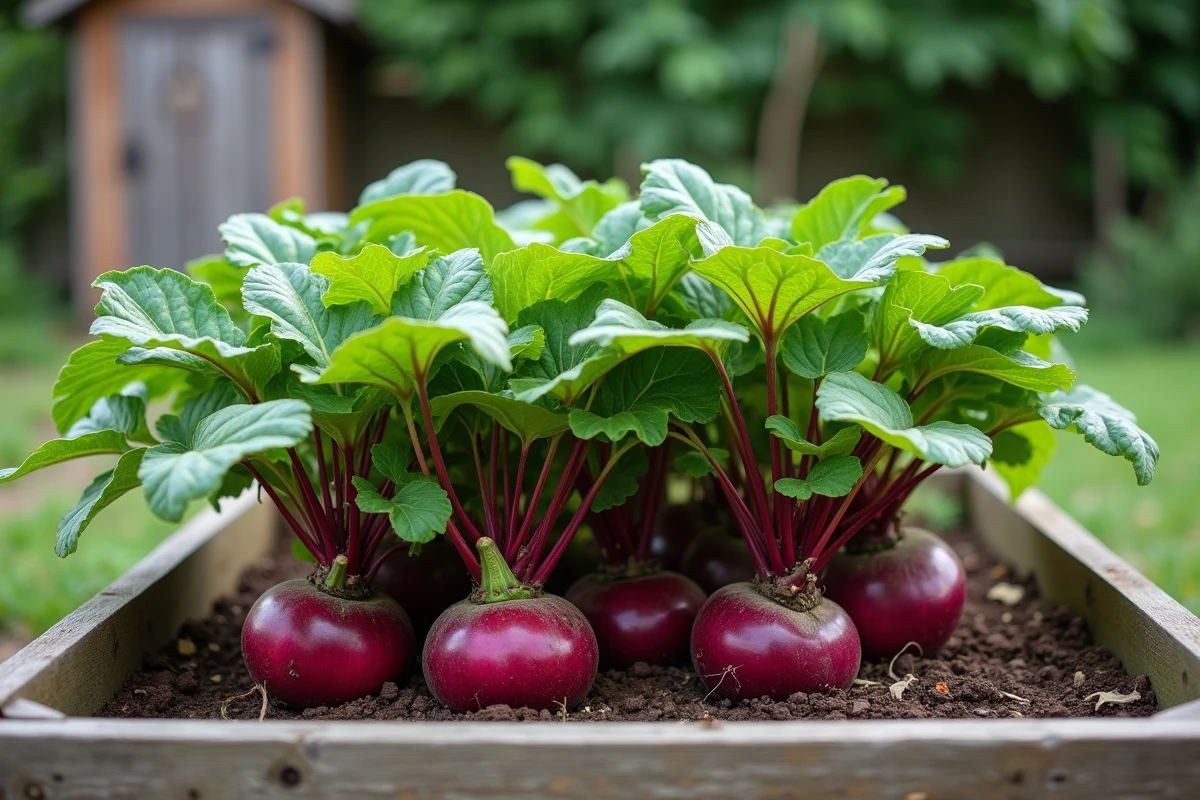
Combining eggplants and beets in the garden raises a rarely asked question: can these two vegetables with opposing requirements coexist without penalizing each other? The eggplant demands warm soil, maximum exposure, and regular water supply. The beet tolerates more temperate conditions and competes little on the surface but remains sensitive to root crowding. Understanding the differences between these two cultural profiles allows for decisions on where, when, and how to bring them closer together.
Comparative cultural needs: eggplant versus beet
| Criterion | Eggplant | Beet |
|---|---|---|
| Botanical family | Solanaceae | Chenopodiaceae |
| Heat requirement | Very high (warm soil, full sun) | Moderate (tolerates partial shade) |
| Water need | Regular and abundant watering | Moderate, tolerates slight water stress |
| Root depth | Deep and spreading roots | Taproot, vertical development |
| Nutrient demand | Very demanding (nitrogen, potash) | Moderately demanding |
| Aerial space | Large foliage, bushy growth | Low foliage, minimal ground cover |
This table highlights a clear imbalance. The eggplant dominates the relationship: it consumes more water, nutrients, and aerial space. The beet, more discreet, risks suffering from the shade of the foliage and root competition if the planting distance is poorly calibrated.
To delve deeper into the parameters of this coexistence, the association of eggplant in the garden on Terre d’Humus details the distances and rotations suitable for each type of soil.
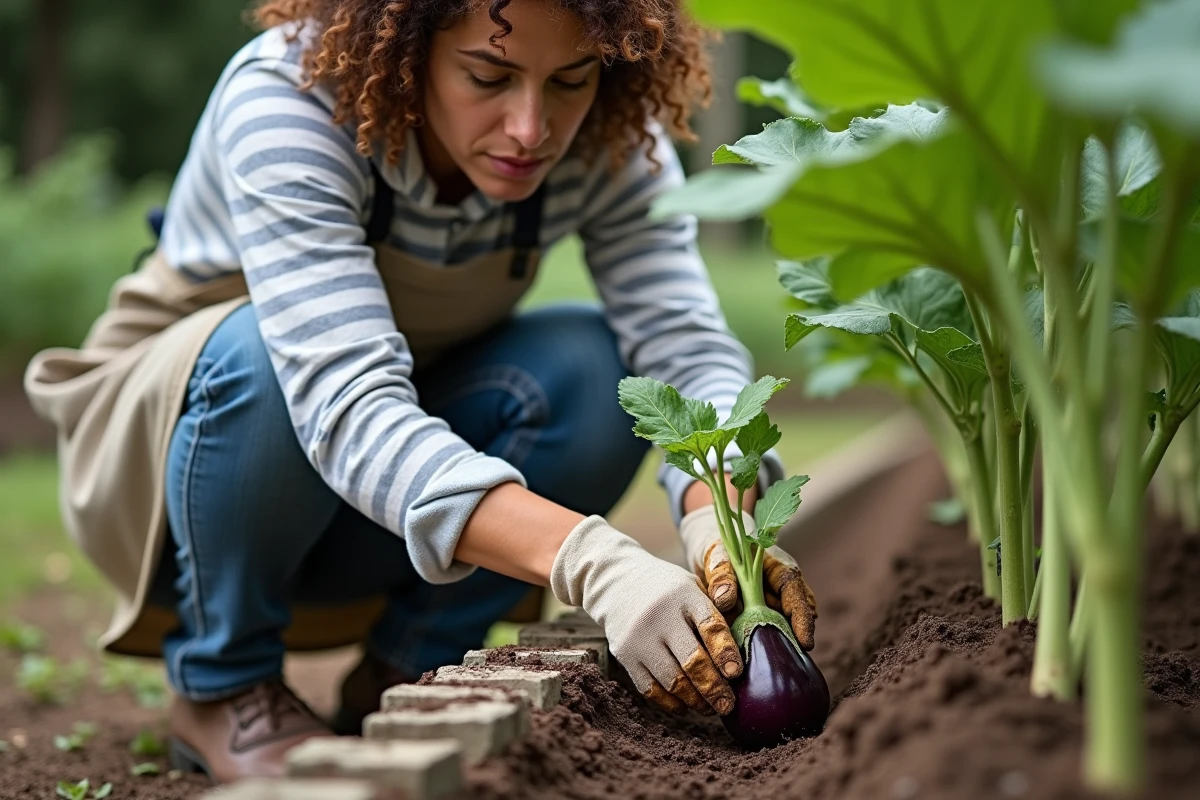
Water management differentiated between eggplant and beet
ITAB (Technical Institute of Organic Agriculture) emphasizes a point often overlooked in companion planting guides: water compatibility takes precedence over botanical proximity. The eggplant needs consistently moist soil at depth, especially during flowering and fruit set. The beet, on the other hand, tolerates slightly drier soil between waterings.
Watering a mixed eggplant-beet bed uniformly creates a concrete problem. Too much water at the base of the beet encourages root splitting and fungal diseases. Not enough water for the eggplant causes flower drop and reduces fruit production.
Two approaches to manage water at the base
- Install a drip system with different flow rates: a higher flow rate at the base of the eggplants, a reduced flow rate for the beets placed at the edge of the bed
- Mulch differently: a thick mulch (straw, hay) around the eggplants to retain moisture, a thinner or absent mulch around the beets to allow the soil to breathe
- Physically separate watering zones by interspersing a row of lettuce or parsley, which absorbs excess water and serves as a water buffer
Differentiated watering at the base is the key to success for this association. Without this management, coexistence quickly turns to the disadvantage of one or the other vegetable.
Spacing and arrangement in the garden: avoiding root competition
The beet competes little on the surface, making it a logical candidate to occupy the free space between eggplant plants. This logic encounters a limit: the root zone of the eggplant extends well beyond its visible foliage.
Planting beets less than thirty centimeters from the base of an eggplant leads to direct competition for nutrients. The beet, being less aggressive, systematically loses this battle. Its roots remain small, fibrous, and sometimes misshapen.
Staggered row arrangement rather than tight intercropping
The most reliable arrangement consists of alternating rows rather than interspersing plants on the same line. A row of eggplants spaced fifty centimeters apart, followed by a row of beets at a distance of forty centimeters, creates a sufficient buffer zone to limit root competition.
This organization has a secondary advantage: the low foliage of the beet covers the soil between the rows of eggplants, which reduces evaporation and limits weed emergence. The beet then plays a role as a living ground cover, useful in a garden where mulching may be lacking.
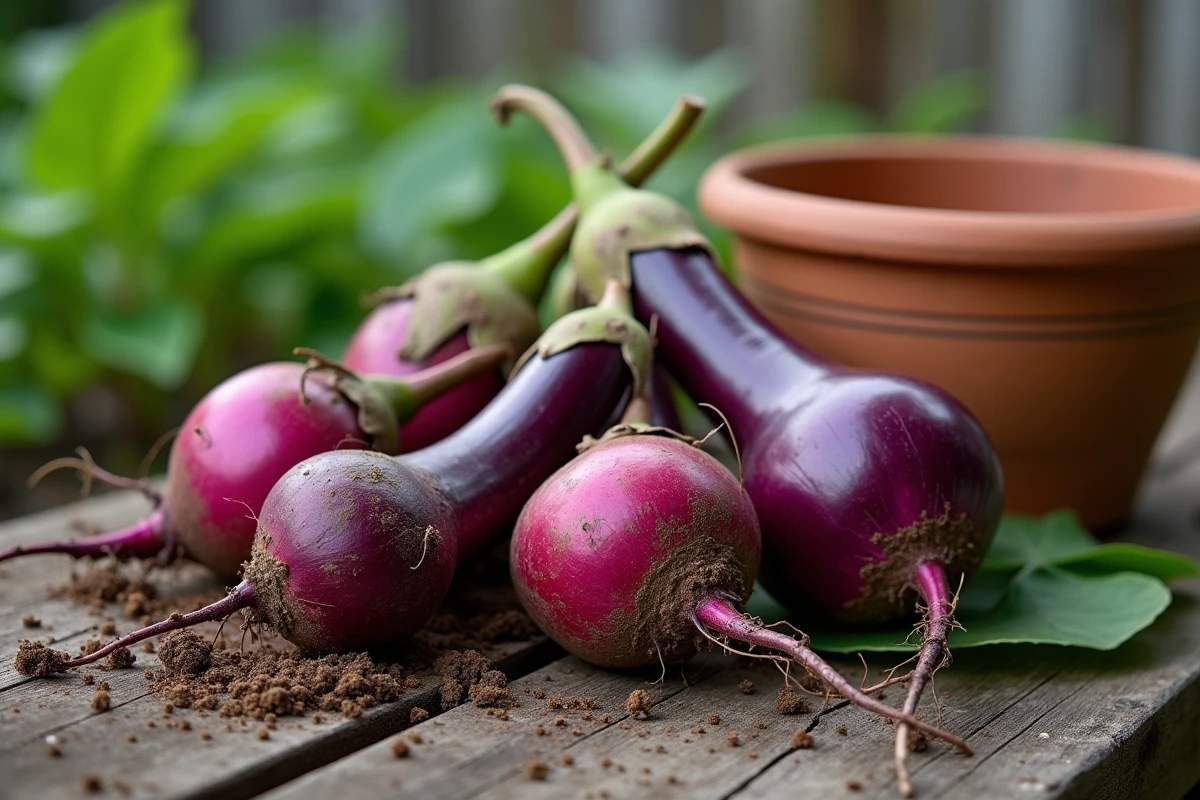
Association under shelter: a common trap for eggplant and beet
Growing eggplant in a greenhouse or tunnel is common in the northern half of France, where heat is lacking in open ground. The temptation to maximize space by adding beets in the shelter seems logical. Recent technical feedback nuances this idea.
In poorly ventilated shelters, residual humidity promotes foliar diseases on solanaceous plants and degrades the quality of beet roots. Downy mildew, botrytis, and collar rot find favorable conditions in these environments. Outdoors, natural air circulation mitigates this risk.
If the shelter has sufficient ventilation (side openings, open ridge), the association remains feasible. In a closed tunnel or poorly ventilated greenhouse, it is better to reserve the space for eggplants only and grow beets in open ground, where they develop without constraint.
Crop rotation and succession after eggplant and beet
Having these two vegetables coexist in the same season does not exempt one from considering the following year. The eggplant, like all solanaceous plants (tomato, pepper, potato), leaves the soil depleted in potash and potentially loaded with specific pathogens. The beet, from the family of chenopodiaceae, does not exacerbate this problem but does not correct it either.
- After an eggplant-beet bed, prioritize a crop of legumes (bean, broad bean, pea) to restore nitrogen to the soil
- Avoid replanting solanaceous or chenopodiaceous plants (spinach, chard) in the same plot for at least two seasons
- Intercrop with a fall green manure (mustard, phacelia) to restructure the soil and limit nematodes
Respecting a two-season interval before returning to solanaceous plants protects the soil and maintains long-term productivity. The eggplant-beet association functions as a temporary duo, not as a pattern to be repeated every year in the same bed.
This duo requires more management than a simple side-by-side planting. Water management by zone, spacing between rows, and the choice between growing under shelter or in open ground determine the outcome. A productive garden relies less on the list of “good associations” than on adapting practices to the real needs of each vegetable.